Get urgent help now
Call 911 now if someone cannot wake up, has slow, uneven, or stopped breathing, has blue or gray lips, collapses, has a seizure, has severe chest pain, or is dangerously confused or agitated.
If an opioid-type overdose is possible and naloxone is available, give it. Do not wait to call 911 or delay rescue breathing or ventilation. Naloxone may need to be given more than once. It may help, but it will not fix every kratom poisoning or another drug’s effects.
For a suspected exposure, call Poison Help: 1-800-222-1222. For suicide or crisis risk, call or text 988.
Quick answer
Kratom is a tree from Southeast Asia. Its leaves contain compounds with opioid-like and other effects. People report using it for pain, energy, mood, or opioid withdrawal. Yet no kratom product is FDA approved to treat an illness.
Kratom can cause side effects. It can also cause physical dependence, withdrawal, and addiction. The risk is harder to predict with extracts, concentrated 7-OH products, lab-made forms, or mixed products.
What to know first
- “Kratom” is not one product. Plain leaf is different from a concentrated shot or a 7-OH tablet.
- Reported relief is not proof of treatment. There are still very few human treatment trials.
- Dependence is not always addiction. Addiction also involves loss of control, harm, or major life problems.
- Labels may be wrong or incomplete. The name, serving size, and listed amount may not match what is inside.
- Mixing raises risk. Alcohol, opioids, benzodiazepines, sedatives, and unknown ingredients can make an emergency more likely.
Legal status — checked August 10, 2026
In California, these products cannot be sold at all. On October 24, 2025, the California Department of Public Health declared that foods, dietary supplements, and medical drugs containing kratom or 7-OH are illegal to sell or manufacture for consumption in this state. This covers ordinary leaf products, not only concentrated ones. It is a food-safety action under the Sherman Food, Drug, and Cosmetic Act. Kratom is not a California controlled substance, so this is not a possession law — but there is no lawful retail source in California. The state has seized more than $5 million in product, and enforcement is active.
Federal law is still in motion. On July 6, 2026, the DEA published two notices of intent to place concentrated 7-OH, and three related lab-made compounds, into Schedule I on a temporary basis. A notice of intent is not a ban. The actual order could not be issued before August 5, 2026, and takes effect the day it is published. As of the date above, that order had not been confirmed as published. This can change quickly.
The proposed federal line is more than 0.050% 7-OH by dry weight for plant material, or more than 0.050%, or more than 1.00 mg of 7-OH per item, for extracts, pills, and edibles. This is a threshold, not a leaf exemption. Most ordinary leaf falls below it, but published testing has found leaf lots reaching roughly 0.2% — well above the line — so a plain leaf product is not automatically outside the federal rule. It is also still not legal to sell in California.
Laws change faster than any article. Check a current official source before relying on this section.
What is kratom?
Kratom is the common name for Mitragyna speciosa. It is a tropical tree in the coffee family. It grows in Thailand, Malaysia, Indonesia, and nearby areas.
For generations, some people in Southeast Asia have chewed fresh leaves or made tea. They report using it for hard work, pain, social customs, and opioid withdrawal. These settings matter. Fresh leaf and traditional tea are not the same as a modern U.S. extract. They are also not the same as a concentrated 7-OH tablet.
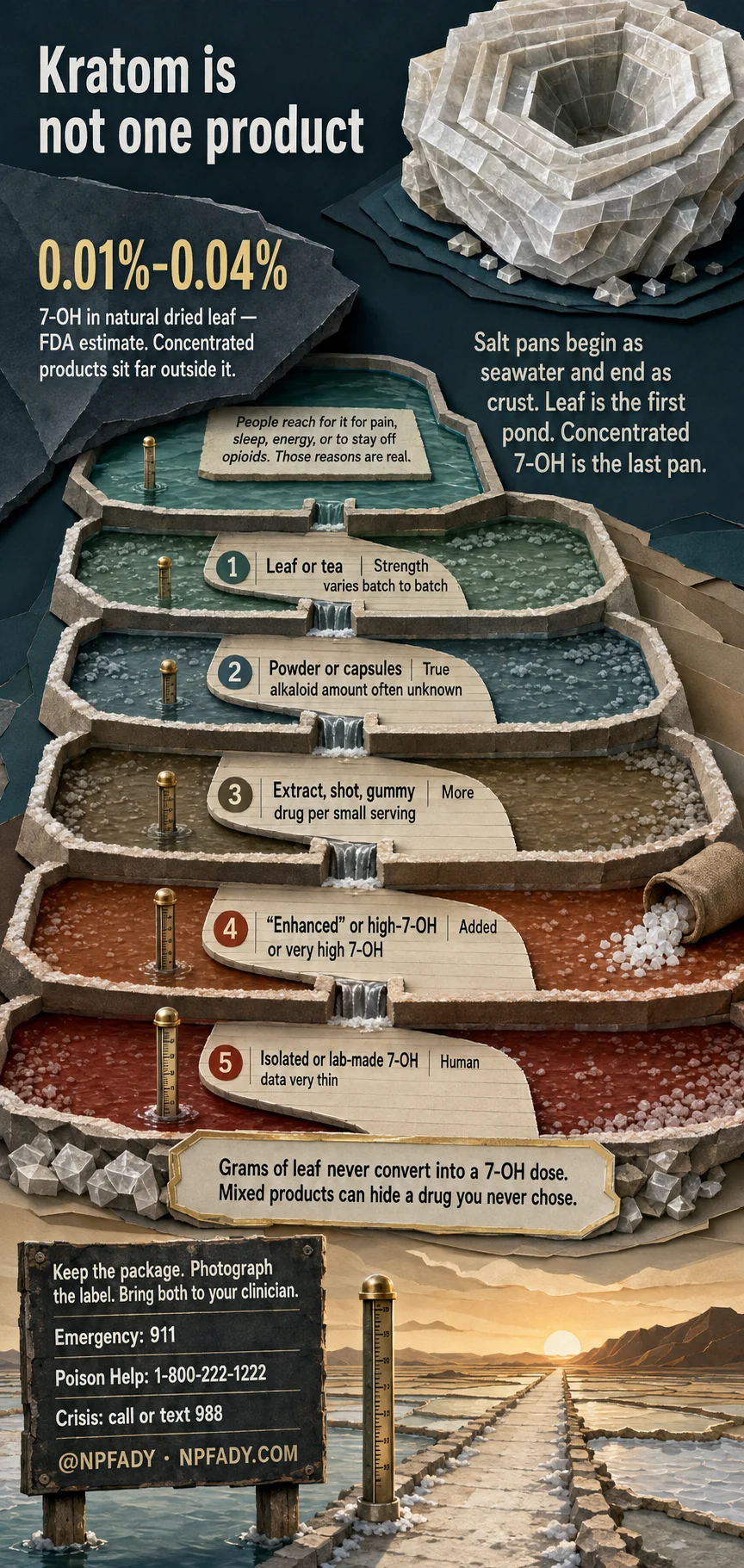
Kratom reached a wider U.S. market as powders and pills. The market then grew to include shots, gummies, drink mixes, and extracts. Some are sold as “enhanced.” Some newer pills or gummies contain isolated or high amounts of 7-hydroxymitragynine. It is called 7-OH or 7-HMG. Other products may contain mitragynine pseudoindoxyl or newer lab-made forms. There is very little human research on these new products.
Why do people use it?
People give many reasons. They may seek more energy, less pain, a better mood, or better sleep. Some hope to ease anxiety. Some use kratom to cut down or replace other opioids. Others use it for pleasure. Some use it to feel normal after their body has become dependent.
These reports deserve respect. They can help a health care worker learn what need the product is meeting. But a survey cannot show that kratom caused a benefit. People choose their own product and dose. They may also change other care at the same time.
U.S. surveys suggest that past-year use is not common, but it is not rare. A study combining the 2021–2023 National Survey on Drug Use and Health put past-year use among adults at 0.68% (95% CI, 0.60%–0.77%). It found no clear change across those years. Earlier national estimates were in the same range. These self-reports do not show the product type, amount, or how often it was used.
There are few controlled human studies. One crossover study included 26 men in Malaysia. They already used a traditional kratom tea. They could bear cold pain for longer after their usual tea than after a placebo. The study did not test long-term pain care. It also did not test U.S. store products. No sound controlled trial has shown that kratom is a safe and effective treatment. This is true for chronic pain, opioid use disorder, anxiety, depression, trauma, focus, and sleep problems.
Research is moving ahead. Early human studies test how the body handles leaf, extracts, and pure mitragynine. A safety study does not prove that a treatment works.
Not all products are the same
Product type is one of the most important safety questions.
| Product | What it may contain | Main concern |
|---|---|---|
| Fresh leaf or traditional tea | Natural leaf alkaloids; strength varies | Most data come from parts of Southeast Asia and may not apply to U.S. products |
| Dried leaf, powder, or ordinary capsules | Ground leaf; the true alkaloid amount is often unknown | The batch or label may be wrong; germs and heavy metals are also a risk |
| Whole-alkaloid extract, resin, shot, gummy, or tablet | Strong mix of leaf alkaloids | A small serving can hold more drug; serving labels may confuse |
| ”Enhanced” or high-7-OH product | Added or very high 7-OH | Strong opioid-like effects, fast dependence, and severe withdrawal are concerns |
| Isolated or semisynthetic 7-OH | Pure or lab-made 7-OH | Human data are very thin; the opioid-like amount can be high |
| Pseudoindoxyl, MGM-15, MGM-16, or another derivative | Lab-made or highly processed opioid-active compound | Most data come from lab or animal work; effects in people are not clear |
| Mixed or unknown product | Kratom plus kava, caffeine, cannabinoids, tianeptine, phenibut, or a hidden drug | Drug effects may mix; the true cause of symptoms may not be clear |
Do not compare grams of leaf with milligrams of 7-OH. They are different measures. There is also no valid “morphine equivalent” for kratom.
Red, green, and white “strains” are common sales labels. People may report a different effect from each color. Yet tests have not shown that the colors mark clear drug types. The batch, how it was made, and how it was stored may matter more. Marketing may matter too.
How it affects the brain and body
Mitragynine is the main alkaloid found in leaf. The body can turn some of it into 7-OH. A product can also have 7-OH in it before use.
Natural leaf holds only a trace of 7-OH. Published measurements put most leaf at roughly 0.003%–0.04% of dry weight, and the FDA’s own scientific assessment reports a mean near 0.01%. Individual lots have measured much higher, up to about 0.2%, so “leaf” is not a guarantee of a low amount. It is a small share of all leaf alkaloids. Some of it forms during drying and processing rather than in the living leaf. None of this gives a sound way to turn grams of a leaf product into a 7-OH amount.
For scale: laboratory testing of products sold as kratom extracts found 7-OH at 22–75 mg per gram — levels the authors concluded were achievable only by synthetic means, with chemical fingerprints unlike any real leaf. That is the gap between the first pan and the last one.
In lab studies, mitragynine and 7-OH act at the mu-opioid receptor. Morphine and fentanyl act there too. But the kratom alkaloids are not the same as those drugs. They may bind with a different strength. They may turn the receptor on in a different way. The body may take them up in a different way. The rest of the product also matters.
Studies also look at effects on adrenaline, serotonin, dopamine, and other brain signals. This may help explain reports of alertness, sweat, fast heart rate, nausea, pain relief, sleep, or distress. Much of this work uses cells or animals. It cannot reliably predict how one person will react.
You may hear that kratom is “biased” and therefore cannot slow breathing. That is not proven. The signal at a receptor can change with the test model. Concentrated 7-OH has slowed breathing in animal studies, an effect reversed by naloxone. Opioid-like breathing problems have also been reported in people. The risk is highest when a product is combined with other things that slow breathing — alcohol, opioids, benzodiazepines, or sedatives.
Small human studies show that mitragynine can stay in the body for many hours. It may build up with repeat use. The numbers vary by product, person, and study. One controlled study of 12 healthy adults found that a tea made with 2 grams of kratom powder raised total midazolam exposure by 39% and peak exposure by 50%. It did not change dextromethorphan exposure in a meaningful way. This points to CYP3A blocking in the gut at that one study amount. It does not show how large every drug interaction will be. Stronger products, repeat use, and other drugs may act differently.
Dependence and addiction are not the same
These words have different meanings.
| Term | Plain meaning |
|---|---|
| Tolerance | The same amount has less effect, or more is needed for the same effect |
| Physical dependence | The body has adapted, so stopping or cutting back can cause withdrawal |
| Withdrawal | Symptoms that appear after use drops or stops |
| Craving | A strong urge or drive to use |
| Addiction, or substance use disorder | A pattern with impaired control, continued use despite harm, or major problems in daily life |
A daily user can have dependence without clear addiction. Someone else may use it less often but still lose control. They may keep using it despite serious harm.
Researchers often use the term kratom use disorder, or KUD. The DSM-5-TR does not name it as a separate diagnosis. Kratom is currently diagnosed under “other or unknown substance use disorder.” Research teams and health care workers adapt the usual 11 substance use disorder signs to kratom, looking across 12 months. Two or three signs suggest a mild disorder. Four or five suggest a moderate one. Six or more suggest a severe one.
Tolerance and withdrawal can raise the count. The full picture matters. A health care worker should ask about control and urges. They should ask about time spent, work, home life, risks, and health. They should also ask about efforts to cut down. A drug’s effect at an opioid receptor does not by itself mean a person has opioid use disorder.
Signs that use may be becoming a problem
Watch for a pattern, not one sign alone:
- using more often or in larger amounts than planned;
- moving from leaf to extracts or high-7-OH products;
- waking at night to use, or using first thing to stop withdrawal;
- strong cravings, or much of the day spent buying, using, or recovering;
- failed efforts to reduce or stop;
- missed work, school, family, or health duties;
- driving or working while impaired;
- continued use after a seizure, liver problem, overdose, or mental health crisis;
- hiding use because of fear or shame;
- returning to fentanyl or another opioid when kratom runs out.
Some online studies link frequent or overnight use with more withdrawal and KUD signs. These studies can find a pattern. They cannot show the rate among all people who use kratom.
What withdrawal can feel like
Symptoms may include craving, anxiety, low mood, irritability, poor sleep, restlessness, fatigue, body aches, chills, sweating, yawning, runny nose, watery eyes, nausea, cramps, vomiting, diarrhea, tremor, or restless legs.
There is no single reliable timeline. Product type and how often or how long a person used it matter. Body chemistry and other drugs matter too. Plain-leaf withdrawal in older studies was often mild or moderate. Selected reports of concentrated 7-OH describe faster cycles, overnight withdrawal, and more severe illness. Neither finding applies to everyone.
Do not assume another illness is “just kratom withdrawal.” Alcohol, benzodiazepine, opioid, tianeptine, or phenibut withdrawal can need urgent care. Infection, pregnancy problems, dehydration, and mental health crises can look similar.
Health risks
More commonly reported effects
- nausea, vomiting, constipation, or stomach discomfort;
- dry mouth, sweating, itching, or poor appetite;
- dizziness, headache, sleepiness, or trouble concentrating;
- fast heart rate, shakiness, anxiety, or agitation.
These effects are not a complete list. A symptom report also may involve another ingredient.
Less common but serious problems
Poison reports and case reports describe seizures, coma, slow breathing, severe agitation, delirium, psychosis, abnormal heart rhythm, fainting, severe dehydration, muscle breakdown, kidney injury, and liver injury. Most evidence cannot give a rate. Many reports involve extracts, unknown products, or other substances.
In U.S. poison-center data, 14,449 kratom-related exposure reports were recorded from 2015 through 2025. Reports rose from 258 in 2015 to 3,434 in 2025 — an increase of roughly 1,200%, with a sharp jump in the most recent year. The product type was not reliably known. Reports involving more than one substance had more hospital care and more serious outcomes than single-substance reports. These voluntary reports show a growing safety signal. They do not show the chance that any one person will be harmed.
Death records need care. A detected chemical does not prove cause. In a 2016–2017 review from 27 states, 152 overdose decedents tested positive for kratom. Fentanyl, heroin, benzodiazepines, prescription opioids, and cocaine were often also present. Seven had no other positive test, though not every possible substance was tested, and later work found additional substances in some of those cases.
A note on kava-kratom drinks
Kratom is increasingly mixed into kava drinks marketed as an alcohol alternative, often sold near college campuses. A separate CDC review of poison-center data through 2025 found kava-related reports rising sharply, with roughly a third of recent kava reports also involving kratom, and serious outcomes about doubling. Both products can affect the liver. Treat these drinks as a real exposure, not a wellness beverage.
Liver warning
Get prompt medical care for yellow eyes or skin, dark urine, pale stools, severe itching, lasting pain under the right ribs, unusual fatigue, or repeated vomiting. Published liver-injury cases often began within weeks and could cause jaundice. A clinician should also check medicines, alcohol, infection, and other causes.
Uncertain or emerging risks
Evidence is insufficient to define long-term effects on hormones, fertility, memory, sleep, driving, or work safety. There are scattered reports, but product type and other causes are often unclear. That uncertainty is a reason for honest monitoring, not a claim that harm is certain.
Why mixing can raise risk
Alcohol, opioids, benzodiazepines, gabapentinoids, sedating antihistamines, and sleep medicines can add to sleepiness or breathing problems. Stimulants can add to agitation, high temperature, fast heart rate, or blood pressure changes. Serotonin-active or QT-prolonging medicines may add risk in a vulnerable person, although direct kratom interaction data are limited.
Some “wellness” shots combine kratom with kava or caffeine. Other retail products may contain tianeptine or phenibut. A lifetime history of another drug is not the same as taking it at the same time. Tell emergency staff what was used, when, and whether it was used at the same time.
Contamination, potency, and labels
FDA testing has found lead and nickel in sampled kratom products. A 2018 outbreak linked kratom products to 199 Salmonella illnesses across 41 states; about 38% of those with available information were hospitalized, and no deaths were reported. These events do not mean every batch is contaminated. They show why source and lot information matter.
Recent laboratory studies have found large differences between some labels and measured alkaloids. Some high-7-OH products contained amounts far above ordinary leaf chemistry. “Third-party tested” does not tell you which lab, which batch, which methods, or which limits were used.
Keep the package and take clear photos of the front, back, lot number, and ingredient panel. Clinicians or poison specialists may need them.
Who may face greater risk?
Extra care is warranted for:
- children and teens, including accidental use of candy-like gummies;
- pregnant or breastfeeding people, because case reports describe dependence in the parent and withdrawal in the newborn, while safety data are poor;
- older adults and people who fall easily;
- people with liver, kidney, heart, seizure, lung, or serious stomach disease;
- people with depression, bipolar disorder, psychosis, or suicide risk;
- people with current or past opioid use disorder, another substance use disorder, or prior overdose;
- anyone taking many medicines, especially sedatives or medicines with a narrow safety range.
Pregnancy and youth guidance cannot be built from a few case reports. Call the appropriate obstetric, pediatric, addiction, or poison specialist rather than making sudden changes alone.
Emergency warning signs
Call 911
Call for difficult arousal; slow, uneven, or stopped breathing; blue or gray lips; choking or inability to protect the airway; seizure; collapse; severe confusion; hallucinations; dangerous agitation; very high temperature; chest pain; fainting; severe dehydration; yellow skin or eyes with confusion or bleeding; suicidal intent; a child’s exposure; or a serious pregnancy concern.
Give naloxone if opioid-type overdose is possible and it is available. Start rescue breathing or ventilation if trained, and follow the dispatcher. Naloxone often needs to be given more than once, and it does not replace airway support or emergency care. Call Poison Help at 1-800-222-1222 for exposure advice. Call or text 988 for suicide or crisis risk.
What to do right now if you are worried
- Check immediate safety. If a red flag above is present, call 911.
- Do not leave an impaired person alone. Place an unconscious person who is breathing on their side if it is safe to do so. Follow dispatcher instructions.
- Save the product details. Bring the package or photos. Note the last use and every other substance.
- Do not add alcohol, sedatives, stimulants, or another “detox” product. Mixing can hide or worsen the problem.
- Ask for a medical assessment. A clinician can check withdrawal, mental health, pain, other substance use, and the exact product.
- Avoid shame. Calm facts make it easier to say what happened and accept help.
Myth versus fact
Myth: “It is natural, so it is safe.” Fact: A plant can have strong drug effects. The product can also be concentrated or contaminated.
Myth: “All kratom is the same.” Fact: Leaf, extract, high-7-OH tablets, synthetic derivatives, and mixed shots can create very different exposures.
Myth: “Physical dependence always means addiction.” Fact: Dependence means the body adapted. Addiction also involves impaired control, harm, or major life problems.
Myth: “Kratom is proven to treat opioid addiction.” Fact: Some people report using leaf to avoid more dangerous opioids. Controlled evidence has not shown kratom to be an effective treatment for opioid use disorder.
Myth: “Kratom is just as dangerous as fentanyl.” Fact: Products and hazards differ. It is wrong to treat ordinary leaf as fentanyl, and it is also unsafe to dismiss concentrated 7-OH or mixed products.
Myth: “A legal product must be FDA approved.” Fact: Store or online sale is not FDA approval. As of August 10, 2026, the FDA had approved no kratom or 7-OH drug. In California, these products are not legal to sell at all.
Myth: “Red, green, and white labels reliably predict effects.” Fact: These labels have not shown consistent chemical profiles across products.
Myth: “Concentrated 7-OH is the same as ordinary leaf.” Fact: Natural leaf contains only a small share of 7-OH. A concentrated product can produce a very different opioid-like exposure.
Myth: “Third-party testing guarantees safety.” Fact: Testing can help only if the lab, method, batch, and standards are clear. It cannot prove a product is safe for one person.
Myth: “Naloxone will fix every kratom poisoning.” Fact: Naloxone may reverse opioid-like breathing depression, and often needs more than one dose. It will not treat every ingredient, seizure, rhythm problem, or liver injury.
Frequently asked questions
Is kratom an opioid?
Kratom is a plant, not a poppy-derived opioid. Yet some leaf alkaloids activate opioid receptors, and concentrated 7-OH acts much like a conventional opioid. Both facts matter, because kratom products differ so widely.
Is kratom legal where I live?
In California, foods, dietary supplements, and drugs containing kratom or 7-OH have been illegal to sell or manufacture for consumption since October 24, 2025. That includes plain leaf products. Kratom is not a California controlled substance, so this is a sales prohibition rather than a possession law. Some California cities have added their own bans.
Federal food and drug rules are separate from controlled-substance scheduling. As of August 10, 2026, the DEA had published two July notices of intent covering concentrated 7-OH and three related compounds. Those notices were not yet confirmed to be effective scheduling orders, and the earliest possible date for such an order was August 5, 2026. Other states and cities have their own rules. Check a current official source.
Will a basic drug test find kratom?
Most standard opioid drug screens do not include mitragynine or 7-OH. A lab can use a targeted mass-spectrometry test. A positive result shows exposure. It does not prove the amount, exact product, impairment, or cause of an event.
How long does kratom stay in the body?
No single detection window has been validated. Small studies show wide variation and possible buildup with repeated use. Do not treat commercial detection claims as clinical rules.
Does daily use mean addiction?
No. Daily use raises concern for physical dependence. Addiction also requires a wider pattern of impaired control or harm. Overnight use, failed efforts to cut down, strong urges, and lost function deserve attention.
Can kratom cause an overdose?
Severe poisoning can occur. It may include opioid-like breathing depression. Risk may be greater with concentrated 7-OH, unknown products, or mixtures with other depressants. Exact rates are not known.
What if kratom kept me off fentanyl?
Tell your clinician. That harm-reduction goal matters. A sound plan should guard against a return to fentanyl. It should also offer proven treatment for opioid use disorder when the diagnosis fits.
Where can I get help?
Use FindTreatment.gov or call SAMHSA at 1-800-662-HELP (4357), 24 hours a day. Ask for an assessment that covers the product, withdrawal, kratom use disorder, opioid use disorder, pain, and mental health.
If you want to read more about what treatment actually involves, see Treating Kratom Dependence and Addiction: What Recovery Looks Like.
Medical disclaimer
This article provides education, not diagnosis or personal medical advice. Products and laws change quickly. Do not use it to start, stop, or dose a medicine or to manage a serious exposure at home. In an emergency, call 911.
Selected references
- U.S. Food and Drug Administration. FDA and Kratom.
- U.S. Food and Drug Administration. Hiding in Plain Sight: 7-OH Products. Content current as of July 13, 2026.
- U.S. Food and Drug Administration. 7-Hydroxymitragynine (7-OH): An Assessment of the Scientific Data and Toxicological Concerns Around an Emerging Opioid Threat.
- National Institute on Drug Abuse. Kratom.
- California Department of Public Health. Foods, Dietary Supplements and Medical Drugs Containing Kratom and 7-OH are Dangerous and Illegal to Sell or Manufacture for Consumption. NR25-016, October 24, 2025.
- Drug Enforcement Administration. Temporary Placement of 7-Hydroxymitragynine Above a Specified Threshold in Schedule I. Federal Register. July 6, 2026; 91 FR 40917.
- Drug Enforcement Administration. Temporary Placement of Mitragynine Pseudoindoxyl, MGM-15, and MGM-16 in Schedule I. Federal Register. July 6, 2026; 91 FR 40909.
- Brown PN, Chan M, Zhang X, Brendler T. Elevated 7-hydroxymitragynine levels found in products misbranded as kratom. J AOAC Int. 2026;109(1):124–130. PubMed. doi: 10.1093/jaoacint/qsaf094.
- Garcia-Romeu A, Cox DJ, Smith KE, Dunn KE, Griffiths RR. Kratom (Mitragyna speciosa): user demographics, use patterns, and implications for the opioid epidemic. Drug Alcohol Depend. 2020;208:107849. PubMed.
- Vicknasingam B, et al. Kratom and pain tolerance: a randomized, placebo-controlled, double-blind study. Yale J Biol Med. 2020;93(2):229–238. PubMed.
- Huisman G, et al. Examining the psychoactive differences between kratom strains. Int J Environ Res Public Health. 2023;20(14):6425. PubMed.
- McCurdy CR, et al. An update on the clinical pharmacology of kratom: uses, abuse potential, and future considerations. Expert Rev Clin Pharmacol. 2024;17(2):131–142. PubMed.
- Kruegel AC, et al. Synthetic and receptor signaling explorations of the Mitragyna alkaloids. J Am Chem Soc. 2016;138(21):6754–6764. PubMed.
- Huestis MA, et al. Human mitragynine and 7-hydroxymitragynine pharmacokinetics after single and multiple daily doses of oral encapsulated dried kratom leaf powder. Molecules. 2024;29(5):984. PubMed.
- Tanna RS, et al. Clinical assessment of the drug interaction potential of the psychotropic natural product kratom. Clin Pharmacol Ther. 2023;113(6):1315–1325. PubMed.
- Smith KE, Epstein DH, Weiss ST. Controversies in assessment, diagnosis, and treatment of kratom use disorder. Curr Psychiatry Rep. 2024;26(9):487–496. PubMed.
- Rogers JM, Smith KE, Epstein DH, et al. Kratom addiction per DSM-5 SUD criteria, and kratom physical dependence: insights from dosing amount versus frequency. Drug Alcohol Depend. 2024. PubMed.
- Wightman RS, Hu D. A case of 7-OH mitragynine use requiring inpatient medically managed withdrawal. J Addict Med. Published online August 4, 2025. PubMed. doi: 10.1097/ADM.0000000000001558.
- Towers EB, Thomas YT, Holstege CP, Farah R. Increases in kratom-related reports to poison centers—National Poison Data System, United States, 2015–2025. MMWR Morb Mortal Wkly Rep. 2026;75(11):139–145. CDC. doi: 10.15585/mmwr.mm7511a1.
- Towers EB, Williams IL, Holstege CP, Farah R. Increase in poison center reports linked to kratom-containing kava products—National Poison Data System, United States, 2000–2025. MMWR Morb Mortal Wkly Rep. 2026;75(12):157–163. CDC. doi: 10.15585/mmwr.mm7512a1.
- Olsen EO, et al. Notes from the field: unintentional drug overdose deaths with kratom detected—27 states, July 2016–December 2017. MMWR Morb Mortal Wkly Rep. 2019;68(14):326–327. CDC.
- Ahmad J, et al. Liver injury associated with kratom, a popular opioid-like product: experience from the U.S. Drug Induced Liver Injury Network and a review of the literature. Drug Alcohol Depend. 2021;218:108426. PubMed.
- U.S. Food and Drug Administration. Laboratory analysis of kratom products for heavy metals.
- Centers for Disease Control and Prevention. Multistate outbreak of Salmonella infections linked to kratom. 2018.
- Wright ME, et al. Outcomes of mothers and newborns to prenatal exposure to kratom: a systematic review. J Perinatol. 2021;41(6):1236–1243. PubMed.
- Helander A, Rylski A. Drug testing for mitragynine and kratom: analytical challenges and medico-legal considerations. Drug Test Anal. 2023;15(2):213–219. PubMed.
- Mun CJ, Timmons P, Cano M. Prevalence and correlates of past-year kratom use among U.S. adults: findings from the 2021–2023 National Survey on Drug Use and Health. J Addict Med. 2026. PubMed.
- Substance Abuse and Mental Health Services Administration. FindTreatment.gov.
If you or someone you know is in crisis
- Call 911 or go to your nearest emergency room for any life-threatening emergency.
- 988 Suicide & Crisis Lifeline — call or text 988, available 24/7. En español: marque 988 y oprima 2. Veterans: 988 and press 1, or text 838255.
- Crisis Text Line — text HOME to 741741.
- The Trevor Project (crisis support for LGBTQ+ young people) — call 1-866-488-7386, or text START to 678-678.
- National Sexual Assault Hotline (RAINN) — call 1-800-656-HOPE (4673) or text HOPE to 64673; free, confidential, 24/7. Online chat at RAINN.org/hotline.
- National Domestic Violence Hotline — call 1-800-799-SAFE (7233) or text START to 88788; 24/7, help in 200+ languages. Online chat at TheHotline.org. If your phone or computer may be monitored, calling from a safer device is an option.
- Riverside County — Inland SoCal Crisis Helpline 951-686-HELP (4357), 24/7 (Inland SoCal United Way / 211+, in partnership with RUHS-BH); Community Access, Referral, Evaluation and Support (CARES) Line 800-499-3008, 24/7.
- San Bernardino County — Access Unit (Behavioral Health Helpline) 888-743-1478, 24/7; Mobile Crisis/CCRT 800-398-0018 (24/7, all ages) or text 909-420-0560. Arrowhead Regional Medical Center (ARMC) has a dedicated walk-in adolescent psychiatric ER (ages 13–17).
- Children under 13 — call 911 for immediate danger, contact your county's mobile crisis team (they respond to all ages), or go to the nearest pediatric emergency room.
- California Peer-Run Warm Line (non-crisis — someone to talk to) — call or text 1-855-600-WARM (9276); daytime and evening hours, not a 24/7 line.
- NP Fady (non-emergency) — for routine scheduling or questions, call (909) 707-6261. This line is not monitored for emergencies.