Get urgent help now
Call 911 now if someone cannot wake up or has slow, uneven, or stopped breathing. Call for blue or gray lips, collapse, a seizure, severe chest pain, or unsafe confusion or agitation.
If an opioid-type overdose is possible and naloxone is available, give it. Do not wait to call 911 or delay rescue breathing or ventilation. Naloxone may need to be given more than once. It may help, but it will not fix every kratom poisoning or another drug’s effects.
For a suspected exposure, call Poison Help: 1-800-222-1222. For suicide or crisis risk, call or text 988.
Quick answer
Recovery starts with a careful clinical assessment of the exact product, withdrawal, other drug use, health, and goals. Treatment may include medical monitoring, symptom relief, counseling, pain or mental health care, harm reduction, and sometimes medication.
No medication is FDA approved specifically for kratom use disorder, and no major U.S. expert group has published a treatment guideline for it. Clinical reviews and expert opinion do exist, and they generally extend what is known from opioid use disorder care. A person who also has opioid use disorder should still be offered established treatment for it.
Five key takeaways
- The product changes the plan. Plain leaf is not the same as a concentrated 7-OH tablet.
- Dependence is not a moral failure. The body can adapt to repeated exposure.
- There is no single withdrawal clock. Timing and severity vary.
- Medication decisions are individual. Case reports are not a universal protocol.
- Recovery is more than stopping. Safety, function, connection, and treatment of the original problem all matter.
You are not weak, and you do not have to do this alone
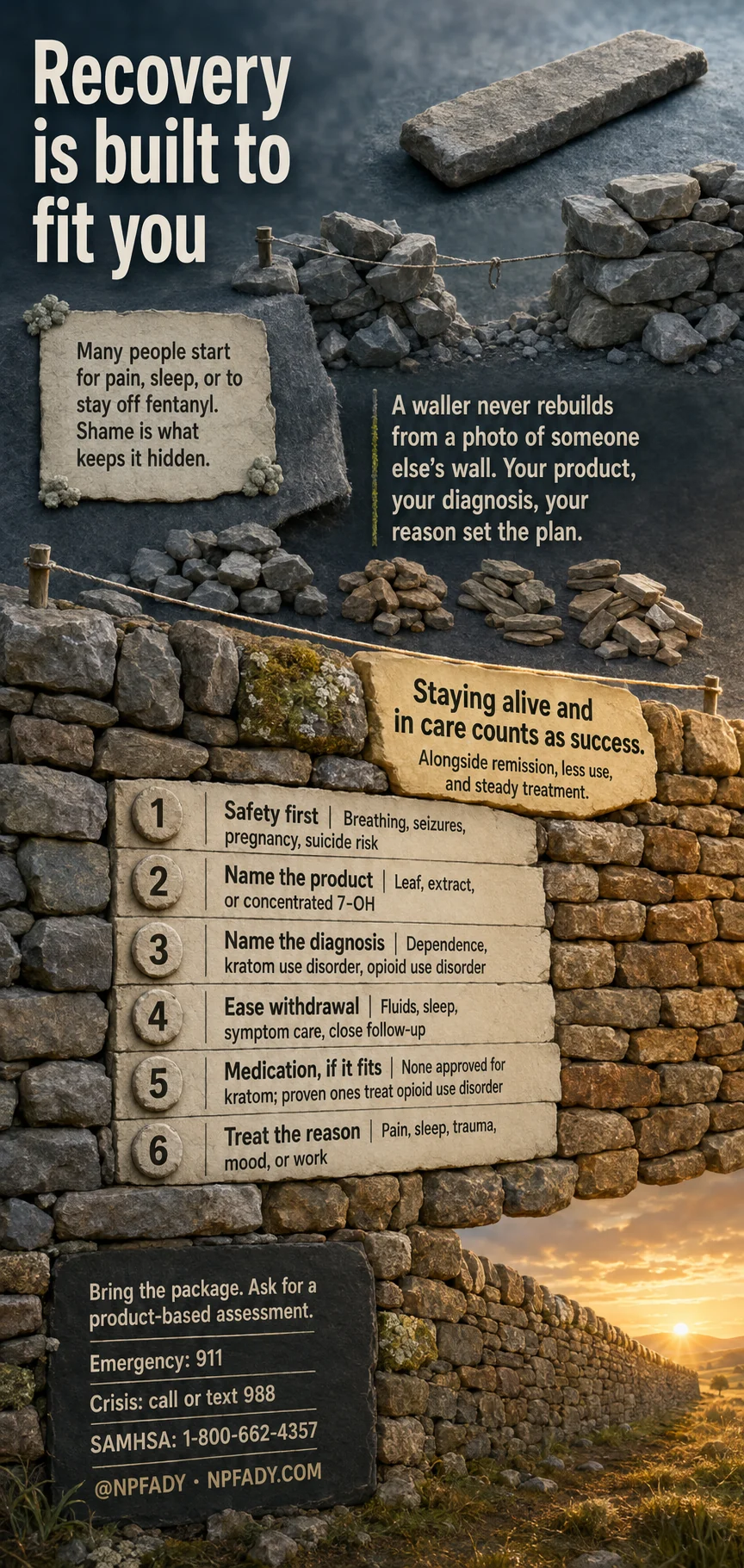
Many people start kratom for a reason. They may use it for pain or sleep. Some use it to cope with trauma, ease opioid withdrawal, or stay away from fentanyl. Dependence can still grow from a goal that made sense.
Shame makes honest care hard. A good care team asks, “How has this product helped you, and what harm does it cause now?” The answer can lead to a safer plan.
There is hope even though published treatment evidence is limited. Teams can still perform a careful assessment, use established emergency care, and offer proven opioid use disorder treatment when that diagnosis is present. For uncertain choices, the patient and team can decide together.
Dependence, withdrawal, and addiction
Physical dependence means the body has adapted, so a quick drop in use can cause withdrawal. Withdrawal is the group of symptoms that follows. Addiction, also called a substance use disorder, adds loss of control, continued use despite harm, or major problems in daily life.
Researchers often use the term kratom use disorder, or KUD, although the DSM-5-TR does not list it by name. Kratom is currently diagnosed under “other or unknown substance use disorder.” Care teams apply the same 11 substance use disorder signs to kratom. Two or three signs suggest mild severity; four or five suggest moderate; six or more suggest severe.
Tolerance and withdrawal count, but they are not the whole story. The team also asks about craving and loss of control. They ask about unsafe use, health harm, work, close ties, and failed tries to cut down.
Kratom use disorder is not the same as opioid use disorder. A person may have one, the other, or both. They may also have physical dependence without either disorder. This changes the care plan.
Why the exact product matters
Bring the package or clear photos if you can. The care team should ask about:
- the name, maker, lot, place of purchase, and ingredient list;
- leaf powder, extract, shot, gummy, tablet, “enhanced” product, 7-OH, 7-HMG, or synthetic relative;
- the label’s serving size and listed mitragynine or 7-OH amount;
- how many times you use it, including overnight;
- how long you have used it, whether use went up, and the last use;
- the reason for use and what happens when you miss it;
- every medicine, supplement, drink, or drug used at the same time.
A label is a clue, not proof. Laboratory testing of products sold as kratom extracts has found 7-OH at levels achievable only by synthetic means, with chemical fingerprints unlike real leaf. Grams of leaf cannot be converted into a 7-OH amount or a morphine equivalent.
Tell the team about all drugs and medicines. This includes fentanyl, methadone, buprenorphine, tramadol, alcohol, benzodiazepines, gabapentinoids, tianeptine, phenibut, kava, stimulants, and sleep aids. A hidden or missed drug can change withdrawal and make a medicine less safe.
A California note. Since October 24, 2025, foods, dietary supplements, and drugs containing kratom or 7-OH have been illegal to sell or manufacture for consumption in California — including plain leaf products. Kratom is not a California controlled substance, so this is a sales prohibition, not a possession law. You will not be arrested for telling your clinician what you have been using, and you should tell them. Accurate information about the product is the single most useful thing you can bring to the visit.
What happens at the first assessment?
The visit starts with safety. The team checks breathing, alertness, blood pressure, pulse, temperature, fluids, and severe withdrawal. They ask about seizures, fainting, chest pain, vomiting, yellow skin or eyes, and pregnancy. They also check for psychosis, mania, and suicide risk.
Next comes the use pattern. The team checks for dependence, kratom use disorder, opioid use disorder, other drug use, and past overdose. They ask what happened during past attempts to change. They also ask about pain, sleep, mood, trauma, work, housing, support, and the goal for today.
A common urine drug screen often does not test for mitragynine or 7-OH. A special lab test may find them. A positive test does not show the amount, exact product, level of harm, or cause of an illness.
Not everyone needs blood tests or an ECG. Symptoms and health history guide the choice. Yellow skin or eyes may call for liver tests. Chest pain, fainting, or heart risk may call for an ECG. Severe vomiting may call for salt and kidney tests.
Outpatient care or a higher level?
Outpatient care may fit a stable adult with mild symptoms. The person must have no high-risk withdrawal from another drug. Safe housing, a working phone, and a clear follow-up plan also matter. The team may discuss symptom care or a slow, supervised reduction. No study proves one best method.
Emergency or hospital care is safer when a person is hard to wake, breathes slowly, or has blue lips. It is also safer for a seizure, delirium, psychosis, very high fever, major heart signs, severe fluid loss, or suicide risk. Yellow skin or eyes with severe illness, and any child’s exposure, also need urgent care. Pregnancy, youth, concentrated 7-OH, and unknown mixtures may call for close watch. The same is true for alcohol or benzodiazepine withdrawal, major illness, unsafe housing, or many failed attempts at care.
The amount used alone does not show which level of care is best. Intensive outpatient care gives several visits a week. Residential care is live-in care. The team weighs health risk, mental health, other drugs, daily life, home, support, and the person’s goals.
What withdrawal can feel like
Mind and mood signs can include craving, anxiety, low mood, irritability, poor sleep, and a need to move. Body signs can include aches, chills, sweat, yawns, runny nose, watery eyes, nausea, cramps, vomiting, diarrhea, shakes, and restless legs.
There is no sound clock for everyone. Product strength, how often it is used, night use, and length of use all matter. Liver health and other drugs matter too. Small leaf studies often found mild or moderate signs. A few reports of concentrated 7-OH found severe overnight withdrawal. Neither result fits every person.
An opioid withdrawal score can help the team track signs. It has not been well tested for kratom or 7-OH. The score also cannot rule out alcohol withdrawal, an infection, a pregnancy problem, mania, or another crisis.
Supportive and symptom-focused care
Care may include fluids, food, help with sleep, and a calm place. The team may also treat nausea, diarrhea, pain, anxiety, or blood pressure change. The choice depends on health, other drugs, pregnancy, and the risk of sleepiness or heart harm.
This is not a do-it-yourself drug list. Benzodiazepines, gabapentinoids, high-dose loperamide, sleep aids, alcohol, tramadol, tianeptine, phenibut, and “detox” products can all cause harm. They may cause a new dependence, heart harm, seizures, confusion, or slow breathing.
A care team may discuss a slow reduction of one known product for a stable person. No taper plan has been proven for all people. Labels may also be wrong. Do not stop, taper, or switch products based on this page alone.
What is known about medication?
No medicine is FDA approved for kratom use disorder or 7-OH withdrawal. Evidence for kratom use disorder alone comes mostly from reports of one or a few patients. Buprenorphine and methadone are FDA approved for opioid use disorder. They should be offered when a person meets the criteria for that diagnosis on their own.
Buprenorphine
Buprenorphine can ease opioid withdrawal and craving. Case reports and small series describe off-label use for some people with severe kratom use disorder or concentrated 7-OH use. No trial has compared it with another plan for this purpose. There is no sound way to convert a kratom amount into a buprenorphine dose.
Starting it too soon can cause precipitated withdrawal. This is a fast, sharp rise in withdrawal when buprenorphine displaces another opioid-like drug from its target. Time since the last kratom use is not enough to show that a person is ready. The product may last longer than expected. Fentanyl, methadone, tramadol, or another opioid may also be present. A trained care team should guide the start. Do not use someone else’s medicine or copy a home start from the internet.
Methadone
Methadone is a proven treatment for opioid use disorder. For that indication it is usually given through a certified opioid treatment program. One 2026 report followed 14 people who received it for kratom use disorder; 13 of the 14 stayed in treatment. That is an encouraging signal, not a reason to treat mild kratom-only dependence this way. Methadone can slow breathing and affect the heart. It needs close monitoring.
Clonidine and lofexidine
These medicines can ease some body signs of opioid withdrawal, such as sweating or restlessness. Most of their use for kratom is extended from general opioid care or small reports. They can lower blood pressure and cause fainting or dizziness. They do not treat addiction on their own.
Naltrexone
Naltrexone blocks opioid targets in the body. It is used for opioid use disorder or alcohol use disorder in some people. It can cause fast, severe withdrawal if opioid-like kratom effects still remain, and kratom case reports document exactly this. The care team must judge that physical dependence has ended, using the current drug label and opioid use disorder guidance. There is no proven waiting period for kratom or 7-OH. A date on a calendar or a common urine drug test is not enough.
When medication may or may not fit
A short plan for symptom relief may fit a stable person with mild plain-leaf dependence, no opioid use disorder, and good follow-up. More intensive care may fit severe kratom use disorder, rapid 7-OH use and withdrawal, failed attempts to change, major harm to daily life, past opioid use disorder, or a high risk of returning to other opioids.
Long-term opioid medicine can save a life when a person has opioid use disorder. Yet it may add long-term opioid exposure that is not needed for every daily leaf user. The key question is not, “Does kratom act like an opioid?” It is, “What illness, product, risk, and goal does this person have?”
Counseling and recovery support
Medicine, when used, is one part of care. Other useful parts may include:
- motivational interviewing, which explores goals without pressure;
- CBT-based tools, which teach ways to cope with craving, stress, and hard thoughts;
- contingency management, which gives set rewards for steps toward a goal and works for some substance use disorders;
- peer or mutual-help support that respects the person’s goals;
- pain rehabilitation, physical therapy, and non-opioid pain care;
- sleep treatment and a steady daily routine;
- care for depression, anxiety, trauma, bipolar disorder, or psychosis;
- family education and practical help with housing, work, food, or transport.
These forms of care work for other substance use disorders. Few studies have tested them specifically for kratom. The team should track safety and daily life, not just a lower product count.
Treat the reason use began
Stopping a product without a new way to meet the same need leaves a gap. Ask:
- If it was for pain, what safe pain plan will replace it?
- If it was for sleep, is there insomnia, sleep apnea, trauma, or a schedule problem?
- If it was for mood or anxiety, does a health problem need care?
- If it was to avoid fentanyl, is evidence-based opioid use disorder treatment available now?
- If it was for work or energy, are exhaustion, ADHD, depression, or unsafe work demands involved?
The answer may help prevent a return to kratom or to a more dangerous drug.
If you are not ready to stop
You still deserve care. A harm-reduction visit can cut risk without naming a “safe” amount.
- Avoid concentrated or enhanced 7-OH and unknown lab-made products.
- Do not combine kratom with alcohol, benzodiazepines, sedatives, unprescribed opioids, tianeptine, phenibut, or unknown mixtures. Do not stop prescribed buprenorphine, methadone, or another medicine without the prescribing clinician.
- Do not drive, work at height, swim alone, or operate machinery when you feel drug effects.
- Avoid using alone when overdose risk is high. Keep naloxone nearby when opioids or opioid-like products may be involved.
- Store every product locked away from children and pets.
- Labels and batches can change. A past amount may act differently next time.
- After time away, tolerance may fall. Returning to a prior pattern can be more dangerous.
- Seek prompt care after a seizure, loss of consciousness, breathing problem, chest pain, severe mental change, or jaundice.
These steps cut risk. They do not make a product safe.
Naloxone and an overdose plan
Use naloxone when opioid-type slow breathing may be the cause. It has helped in reported kratom cases, though the evidence comes mostly from case reports. Call 911 first, or at the same time. Give naloxone if it is on hand. Help the person breathe. Naloxone often needs to be given more than once — give further doses as the package or the 911 dispatcher directs. Place an unconscious person who is breathing on their side if it is safe to do so. Stay with them. Other drugs in the product may still need treatment, and naloxone does nothing for those.
Ask a care team or pharmacist for naloxone if there is concentrated 7-OH use. Ask if there is other opioid use, use of sleep medicines, a past overdose, or risk in the home. Everyone around you should know where it is and how to call for help.
Pregnancy and youth safety
Pregnancy: Do not make a sudden change alone. Case reports describe dependence in the parent and withdrawal in the newborn. They do not show the safest care. The plan may need teams for the pregnancy, addiction care, and the newborn.
Children and teens: A child who swallows a product may have an emergency. Call Poison Help now. Call 911 if the child has symptoms. Teens need a child health and mental health check. They need screening for other drugs, family support, and the privacy allowed by local law. Adult case reports are not a care guide for young people.
How family and friends can help
Try: “I care about you. I want to understand what the product does for you and what worries you. Can we call a clinician together?”
Do not shame, threaten, or argue while the person is feeling strong drug effects. Do not throw away the supply in secret. A sudden loss may cause withdrawal or a return to a more dangerous opioid. Do not give borrowed buprenorphine, benzodiazepines, sleep medicines, or other drugs. Keep children safe. Call for urgent help when needed. Talk about change when the person is alert.
Finding qualified help
Use FindTreatment.gov or call SAMHSA: 1-800-662-HELP (4357), available 24 hours a day. Ask the clinician:
- Will you distinguish leaf, extract, concentrated 7-OH, synthetic, and mixed products?
- Can you assess both kratom use disorder and opioid use disorder?
- How will you screen for alcohol, sedative, tianeptine, or phenibut withdrawal?
- What evidence supports the proposed medicine, and what is extended from opioid use disorder care?
- How will you protect against precipitated withdrawal?
- How will pain, sleep, trauma, and mental health be treated?
- What is the follow-up and emergency plan?
A medical toxicologist, addiction team, mental health team, pain team, obstetric team, or child health team may join the plan.
What recovery can look like over time
No one can promise that symptoms will end on a set day. Early care aims to keep breathing safe, restore fluids and sleep, and ease withdrawal. It also checks suicide and overdose risk. Next comes a plan for craving, pain, mood, other drugs, and daily life. Long-term care can protect work, close relationships, health, and purpose.
The next check may be the same day or the next day after an unsafe visit or a new medicine start. Visits are often close together at first. They may spread out as health and daily life improve. Success may mean staying alive and in care. It may mean no 7-OH or fentanyl, less use, better family life, remission, or steady treatment. Not every gain requires full abstinence.
After a return to use
A return to use gives new information. It is not failure. Check for overdose, lost tolerance, a stronger batch, new 7-OH, pain, stress, lost sleep, and gaps in care. Replace naloxone if it was used. Get back in touch quickly, change the plan, and consider more support.
Frequently asked questions
Can I detox from kratom at home?
Some stable adults with mild symptoms can be cared for at home or in a clinic, but this page cannot tell you whether that is safe for you. An unknown product, 7-OH, pregnancy, other withdrawal, illness, suicide risk, or poor support can change the answer. Ask a care team or Poison Help, and call 911 for red flags.
Should I stop suddenly?
Do not use this page to decide. A sudden stop can cause withdrawal, and a poor switching plan can raise overdose risk. A care team can help choose close monitoring, symptom care, a slow supervised reduction, or another plan.
Is buprenorphine the best treatment?
Buprenorphine is proven for opioid use disorder, but not for every case of kratom use disorder. Evidence for kratom and 7-OH comes from small reports. The diagnosis, severity, product, other opioids, and your goals should guide the choice.
How long will withdrawal last?
There is no single timeline. Studies used many products and small groups, and withdrawal can vary with how often a person uses. Get help for symptoms that are severe, worsening, or do not fit the usual pattern.
Will a kratom drug test guide treatment?
A special lab test can show exposure, but it cannot show the amount, exact product, level of harm, or cause of illness. In a crisis, the physical exam and tests for other drugs often guide care more than one kratom result.
Does treatment mean lifelong medication?
Not always. Long-term medicine can cut the risk of death for a person with opioid use disorder, while mild dependence alone may need a shorter plan. The patient and care team should review the benefits, harms, goals, and any wish to taper over time.
What if a clinician dismisses my use as “just a supplement”?
Show the package and explain your use pattern, withdrawal, goals, and every other drug or medicine you take. Ask for a product-based assessment, or a referral to an addiction or poison specialist if the clinician lacks experience.
What if I am using kratom to stay away from fentanyl?
Say so directly, so the plan can protect that gain and offer proven opioid use disorder care without shame. Ask for a planned transition and an overdose plan, so that a lost supply does not lead to an unsafe return to fentanyl.
California made these products illegal to sell. Does that change my treatment?
It changes access, not care. A sales prohibition means supply can disappear without warning, which can force withdrawal on a schedule nobody planned. That is a reason to have a conversation with a clinician now rather than later. It is not a reason to hide your use — kratom is not a California controlled substance, and possession is not the issue.
Emergency and crisis resources
- 911: unresponsiveness, abnormal breathing, blue or gray lips, seizure, collapse, severe chest pain, dangerous confusion or agitation, or immediate suicide danger.
- Poison Help: 1-800-222-1222, poisonhelp.org.
- 988 Suicide & Crisis Lifeline: call or text 988, 988lifeline.org.
- SAMHSA National Helpline: 1-800-662-HELP (4357), 24 hours a day, free and confidential.
- Treatment locator: FindTreatment.gov.
Medical disclaimer
This page teaches general facts. It cannot diagnose you or give personal care. It is not a home detox, taper, or medication guide. Do not start, stop, borrow, or dose a medicine based on this page. In a crisis, call 911.
If you want the background on what these products are and how they differ, see Kratom Explained: Uses, Risks, Addiction, and Warning Signs.
Selected references
- U.S. Food and Drug Administration. FDA and Kratom.
- California Department of Public Health. Foods, Dietary Supplements and Medical Drugs Containing Kratom and 7-OH are Dangerous and Illegal to Sell or Manufacture for Consumption. NR25-016, October 24, 2025.
- Smith KE, Epstein DH, Weiss ST. Controversies in assessment, diagnosis, and treatment of kratom use disorder. Curr Psychiatry Rep. 2024;26(9):487–496. PubMed. doi: 10.1007/s11920-024-01524-1.
- American Society of Addiction Medicine. National Practice Guideline for the Treatment of Opioid Use Disorder: 2020 Focused Update.
- Substance Abuse and Mental Health Services Administration. TIP 63: Medications for Opioid Use Disorder.
- Stanciu C, Ahmed S, Hybki B, Penders T, Galbis-Reig D. Pharmacotherapy for management of “kratom use disorder”: a systematic literature review with survey of experts. WMJ. 2021;120(1):54–61. PubMed.
- Brown PN, Chan M, Zhang X, Brendler T. Elevated 7-hydroxymitragynine levels found in products misbranded as kratom. J AOAC Int. 2026;109(1):124–130. PubMed. doi: 10.1093/jaoacint/qsaf094.
- American College of Medical Toxicology. Interpretation of urine opiate and opioid tests. 2021.
- Rogers JM, Smith KE, Epstein DH, et al. Kratom addiction per DSM-5 SUD criteria, and kratom physical dependence: insights from dosing amount versus frequency. Drug Alcohol Depend. 2024. PubMed.
- Wightman RS, Hu D. A case of 7-OH mitragynine use requiring inpatient medically managed withdrawal. J Addict Med. Published online August 4, 2025. PubMed. doi: 10.1097/ADM.0000000000001558.
- Weiss ST, Douglas HE. Treatment of kratom withdrawal and dependence with buprenorphine/naloxone: a case series and systematic literature review. J Addict Med. 2021;15(2):167–172. PubMed. doi: 10.1097/ADM.0000000000000721.
- Sherrick RC. Treatment of kratom use disorder with methadone in an opioid treatment program. J Addict Med. Published online February 12, 2026. PubMed. doi: 10.1097/ADM.0000000000001666.
- Jarka C, Gregoire K. Precipitated withdrawal with kratom use following naltrexone administration. Ment Health Clin. 2023;13(3):155–158. PubMed.
- Jensen AN, et al. Kratom-induced transaminitis with subsequent precipitated opioid withdrawal following naltrexone. Ment Health Clin. 2021;11(3):220–224. PubMed.
- Overbeek DL, Abraham J, Munzer BW. Kratom (mitragynine) ingestion requiring naloxone reversal. Clin Pract Cases Emerg Med. 2019;3(1):24–26. PubMed.
- Wright ME, et al. Outcomes of mothers and newborns to prenatal exposure to kratom: a systematic review. J Perinatol. 2021;41(6):1236–1243. PubMed.
- Substance Abuse and Mental Health Services Administration. FindTreatment.gov.
If you or someone you know is in crisis
- Call 911 or go to your nearest emergency room for any life-threatening emergency.
- 988 Suicide & Crisis Lifeline — call or text 988, available 24/7. En español: marque 988 y oprima 2. Veterans: 988 and press 1, or text 838255.
- Crisis Text Line — text HOME to 741741.
- The Trevor Project (crisis support for LGBTQ+ young people) — call 1-866-488-7386, or text START to 678-678.
- National Sexual Assault Hotline (RAINN) — call 1-800-656-HOPE (4673) or text HOPE to 64673; free, confidential, 24/7. Online chat at RAINN.org/hotline.
- National Domestic Violence Hotline — call 1-800-799-SAFE (7233) or text START to 88788; 24/7, help in 200+ languages. Online chat at TheHotline.org. If your phone or computer may be monitored, calling from a safer device is an option.
- Riverside County — Inland SoCal Crisis Helpline 951-686-HELP (4357), 24/7 (Inland SoCal United Way / 211+, in partnership with RUHS-BH); Community Access, Referral, Evaluation and Support (CARES) Line 800-499-3008, 24/7.
- San Bernardino County — Access Unit (Behavioral Health Helpline) 888-743-1478, 24/7; Mobile Crisis/CCRT 800-398-0018 (24/7, all ages) or text 909-420-0560. Arrowhead Regional Medical Center (ARMC) has a dedicated walk-in adolescent psychiatric ER (ages 13–17).
- Children under 13 — call 911 for immediate danger, contact your county's mobile crisis team (they respond to all ages), or go to the nearest pediatric emergency room.
- California Peer-Run Warm Line (non-crisis — someone to talk to) — call or text 1-855-600-WARM (9276); daytime and evening hours, not a 24/7 line.
- NP Fady (non-emergency) — for routine scheduling or questions, call (909) 707-6261. This line is not monitored for emergencies.